Tag: 1996 Stanley Cup Final

  • Your Team Will Rise/Fail: 2021-22 Standings Projections

    It is time. The 2021-22 season is upon us.

    Technically it already started, but we’ll ignore the fact that the Pittsburgh Penguins spoiled the Tampa Bay Lightning’s 2021 Stanley Cup champion banner night with a, 6-2, victory on the road before the Vegas Golden Knights held off a Seattle Kraken comeback in a, 4-3, win at T-Mobile Arena on Tuesday night.

    And then Wednesday’s games happened too.

    Let’s hit the “reset” button for a second and pretend the 2021-22 is about to get underway. All 32 National Hockey League teams have a chance at clinching 16 available playoff berths.

    Any of the 16 teams that make the 2022 Stanley Cup Playoffs could etch 52 names from their roster, front office and organization on the Stanley Cup next June.

    The usual divisions– Atlantic, Central, Metropolitan and Pacific– have returned as have the Eastern Conference and Western Conference. The regular playoff format is back (three teams per division, two wild cards per conference qualify, plus the Conference Finals round returns in place of the Stanley Cup Semfinals in 2021).

    A full 82-game regular season schedule is slated from October through the end of April with a three-week break in February for the 2022 All Star Game in Las Vegas and the 2022 Winter Games taking precedence before a return to NHL action down the stretch with the postseason kicking off in May like last year and the 2022-23 season likely returning to the pre-pandemic timeline (2023 Stanley Cup Playoffs starting in April).

    The 2022 NHL Entry Draft will be in Montréal on July 7th and 8th, while free agency begins on July 13th, but between now and then, we’ve got the 2021-22 regular season to enjoy.

    Using last season’s team goals for and team goals against, plus some other “magic numbers” as part of an expected points model, we’re able to project what 2021-22 could be for all 32 teams (yes, even the Seattle Kraken, despite this year being their first season)– though you’ll have to pretend there were no transactions made in the offseason.

    In other words, don’t think that any of what you’re about to see is set in stone– view it more as a suggestion for a possible outcome.

    Also, please remember my degree is in communication, so any math beyond figuring out “goals + assists = season point totals” doesn’t exist.

    In a normal year (like from 2017-18 to 2018-19, for example), you just take all the data from the 82-game schedule for each team plug it into a formula in a spreadsheet, then line things up accordingly in each division.

    However, just like how the shortened 2019-20 season disrupted the regular process for projecting a 2020-21 standings outlook, going from last season’s stats in a 56-game schedule to projecting a regular 82-game season in 2021-22 necessitated the use of forecasting point pace as part of the formula.

    As for Seattle, a simple means of taking the NHL stats from last season for every player on their roster and plugging it in for a 2021-22 result is exactly what I did.

    We’re all just making it up as we go along, folks. These are projections. They are not absolutes.

    For the sake of keeping it simple, here’s a look at how things could go (but probably not) in each division for the upcoming 2021-22 season.
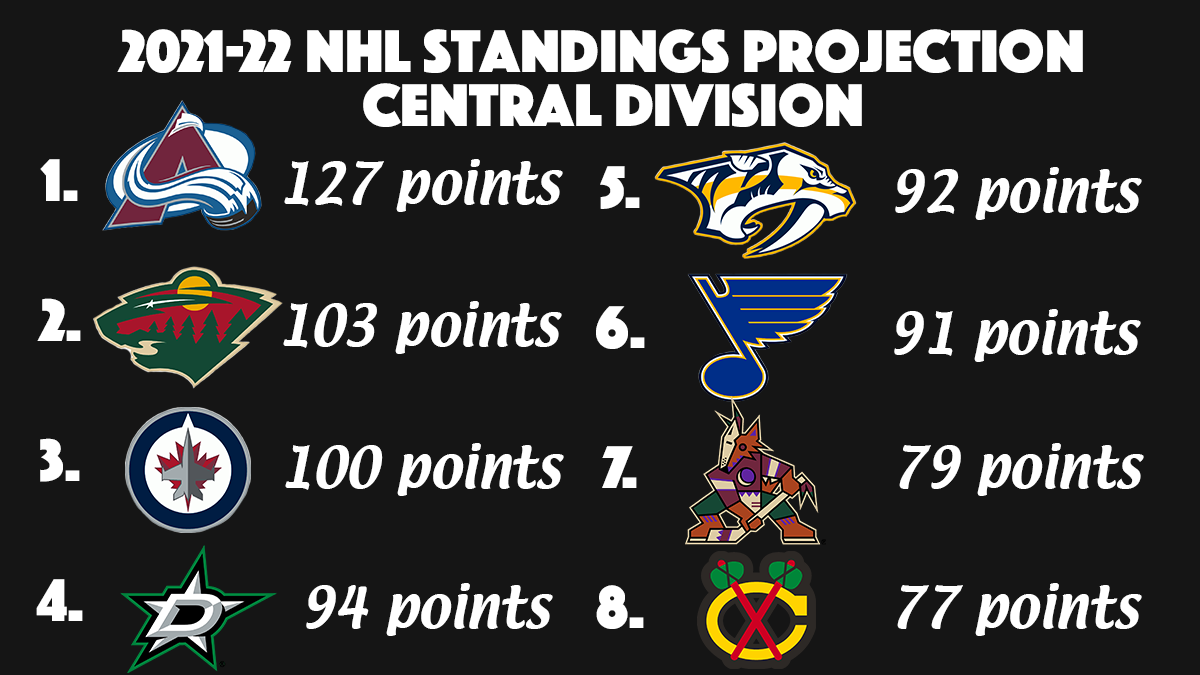
    The overall vibe of the Central Division for 2021-22 is that it’s just more of exactly what you’d expect. The Colorado Avalanche are lightyears ahead of everyone else, while Kirill Kaprizov and the Minnesota Wild continue to be on the rise and everyone else fights for what they can earn.

    Meanwhile, the jury is still out on whether or not the Winnipeg Jets can breakthrough as Canada’s team and break the Canadian curse (become the first Canadian club to win the Cup since 1993).

    Will Colorado finally break through the Second Round and win the Cup?

    Are the Avalanche just the Toronto Maple Leafs but with a little more success? My column:

    No, but really, it’s worth asking if the Avs making it back to the Western Conference Final for the first time since 2002, is more like Toronto’s struggle to make it out of the First Round for the first time since 2004, or is Colorado’s struggle more like the Washington Capitals pre-2018?

    The Caps won three Presidents’ Trophies in 2009-10, 2015-16 and 2016-17, but couldn’t make it past the Second Round– let alone the Pittsburgh Penguins– until they finally did and ended up surging in momentum all the way to their first Stanley Cup in franchise history.

    Colorado, on the other hand, has already won the Cup twice (1996 and 2001) and also has three Presidents’ Trophies to their name in 1996-97, 2000-01 and 2020-21, so if recent history has anything to tell us it’s that yet another team with high expectations for at least a few seasons now only to come up short could very well go on to win it all after winning the Presidents’ Trophy the previous year.

    Either that or they’ll have to win it in back-to-back seasons like Washington did before they won the Cup in 2018.

    Then again, the Tampa Bay Lightning tied the Detroit Red Wings’ record for most wins in the regular season (62), securing the Presidents’ Trophy in the process in 2018-19, then got swept by the Columbus Blue Jackets in the 2019 First Round.

    The very next year, however, Tampa kicked off back-to-back Cup rings in 2020 and 2021, to be where they are now as the two-time defending champions likely standing in the path as the only other favorites outside of the Avalanche this season.

    Anyway, the Avs mostly kept things the same from last season to this season, losing Joonas Donskoi to the Seattle Kraken in the 2021 NHL Expansion Draft, Brandon Saad to the St. Louis Blues in free agency and making minor swaps among replacement level bottom-six forwards and bottom-pairing defenders.

    Oh, then there’s this whole thing about how Philipp Grubauer left for Seattle in free agency too, so Colorado acquired Darcy Kuemper from the Arizona Coyotes.

    Between Dallas, Nashville and St. Louis, who will realistically make the playoffs?

    The Stars are projected to finish with about 94 points, the Predators sit at 92 points and the Blues are around 91 points in this one projection, but don’t let the points alone be your deciding factor.

    Given the strength of the Central Division compared to the Pacific Division, you can bet on five teams making out of the Central among Western Conference playoff berths.

    As such, the spread is the difference maker between these three teams expected to be in the wild card hunt– it’s going to come down to the wire one way or another.

    Dallas bolstered their goaltending depth by signing Braden Holtby, Nashville traded Ryan Ellis to the Philadelphia Flyers and St. Louis is… …better than last season on paper?

    I mean, the Blues signed Saad, acquired Pavel Buchnevich from the New York Rangers in exchange for Sammy Blais, let Seattle claim Vince Dunn at the expansion draft and let Mike Hoffman walk to the Montréal Canadiens in July.

    You could say they took a hit here or there, but those aren’t “nobody names” by any means, however.

    If Jordan Binnington and Ville Husso can stabilize things in the crease, then St. Louis has a better situation than the Predators.

    The Stars, meanwhile, should benefit from a longer season where more of their core guys– like Tyler Seguin, for example– are healthy. Last season’s COVID-19 outbreak to kick things off in January really killed Dallas’ momentum as a team on the verge of being in the 2021 postseason.

    Dallas should get back into the swing of things and St. Louis should be able to stay relevant for at least another year, but how hard the Preds rely on Juuse Saros as their starting goaltender will dictate whether or not they’re able to play spoiler with David Rittich as their backup since Pekka Rinne retired.

    Can Arizona avoid the basement?

    Anything is possible at this point. Loui Eriksson and Andrew Ladd were scoring goals in the postseason, so a fresh start could be just what both players needed for the last few years at least.

    That said, Coyotes General Manager, Bill Armstrong, gave a Masterclass™️ in how to go about rebuilding by selling everything over the summer and taking on “bad” contracts with only one or two years remaining in hopes of playing just well enough to be bad enough without making it look obvious that you’re aiming to win the 2022 NHL Draft Lottery.

    The Pacific Division is the new Scotia NHL North Division from last season. In other words, it’s the worst– which is great news for the Seattle Kraken as the league’s schedule allots more division play than any other opponents (though the Kraken will play every other team in the league at least twice).

    Seattle’s riding the waves of new-age expansion, while the Vegas Golden Knights lead the charge for the Presidents’ Trophy campaign in 2021-22.

    Wait, Seattle in 2nd in the Pacific, really?

    Yes, really.

    The Kraken have a great front office that goes beyond just Ron Francis as General Manager and have done their due diligence in scouting the best talent available to try to replicate the success of the Vegas Golden Knights’ inaugural season in 2017-18, as well as grow beyond just 2021-22.

    That said, Seattle probably isn’t going to make it out of the First Round of the 2022 Stanley Cup Playoffs, even if they have to face the Edmonton Oilers according to this projection.

    It’s a best case scenario for the NHL’s newest expansion team to be in the weakest division, but aside from having recent Stanley Cup champions Yanni Gourde, Philipp Grubauer, Jaden Schwartz and Dunn on their roster, the Kraken have a plethora of players that are relatively inexperienced with deep postseason runs.

    Head coach, Dave Hakstol, also hasn’t had the consistency of making the playoffs and making it out of the First Round in his NHL coaching days, but as a team that, again, is looking to develop long-term success, these are mere growing pains Francis and Co. are willing to accept as the fan base grows.

    Why aren’t the Kings making the cut this year when everyone else says they’ll be the most improved?

    The simple answer is that everyone’s overrating Los Angeles when it comes to the “ready now” factor.

    Sure, Kings General Manager, Rob Blake, did a good thing by getting Viktor Arvidsson in a trade with Nashville this summer to solidify his top-six forward group and signed Alex Edler to fortify his defense, but Los Angeles’ goaltending leaves something to be desired.

    Here’s hoping Jonathan Quick can find a little resurgence at this point in his career, while Cal Petersen continues to come into his own.

    If Los Angeles has any injuries– and they already have with Arvidsson likely missing some time due to an injury in the last preseason game– they’re already close enough to the bubble that they’ll only fall further behind.

    That said, if the Kings don’t make it back to the postseason hunt in 2022, there’s a good chance they make it in 2023.

    Los Angeles is improving, but by how much remains to be seen.

    Will winning the Presidents’ Trophy hurt Vegas?

    Eh, it’s hard to say.

    The Golden Knights have packed in just about every type of heartbreak since their inception in 2017, that fans of other franchises have only experienced over the course of at least 50 years, so if Vegas pulls out the Presidents’ Trophy win in 2021-22, don’t be surprised when the inevitable happens and they win the Cup instead of doing what most other Presidents’ Trophy winners in the salary cap era have done.

    Only the 2007-08 Detroit Red Wings and Chicago in 2012-13, have been able to win the Presidents’ Trophy and the Stanley Cup since the salary cap was introduced ahead of the 2005-06 season.

    Vegas would probably join Detroit and Chicago in doing so just so the Hockey Gods can spite us again.
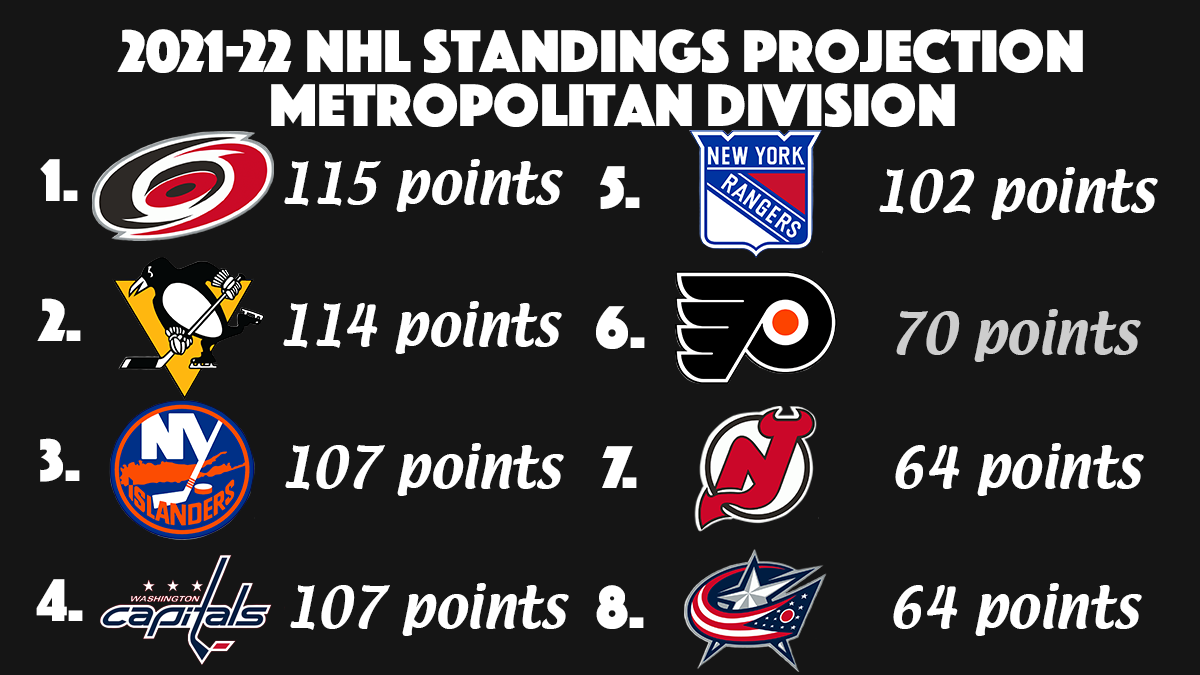
    It’s not easy to be in the Metropolitan Division these days because, well, let’s save that for the three questions below.

    Is this the toughest division to project?

    Absolutely.

    The Carolina Hurricanes decided to just get rid of a few parts and pieces that helped make them good for the last few seasons, so they’re bound to regress even with Sebastian Aho, Andrei Svechnikov, Teuvo Teräväinen and Martin Necas still existing.

    The Pittsburgh Penguins since 2009, have always found a way to be near the top of the division standings by the end of the regular season no matter whether or not you believe they’ll inevitably miss the playoffs for the first time since 2006, so anything could happen there.

    The New York Islanders have made back-to-back appearances in the Eastern Conference Final, so I’d expect them to be good.

    The Washington Capitals are better than the Philadelphia Flyers and New York Rangers, at least, but are probably the only team on the bubble if the New Jersey Devils can come out of nowhere and be competitive this season after signing Dougie Hamilton, Tomas Tatar and Jonathan Bernier in the offseason.

    Meanwhile, it’s time for a short rebuild in Columbus as the Blue Jackets would be quite pleased with a top draft pick in 2022.

    What if Chris Drury never was promoted as General Manager of the Rangers?

    They’d still fire David Quinn and hire Gerard Gallant. I don’t think that’s such a bad idea, but they’d definitely reconsider about 90% of the roster decisions made this summer.

    There’s no reason why the Rangers have to go down this path and yet, here they are, fumbling at the one-yard line and possibly plunging their franchise back into the Dark Ages of another rebuild. Or is it the same ongoing rebuild?

    What about a team to watch like New Jersey, for example?

    I’m big on the Devils this season for some strange reason.

    Maybe it’s because a part of me deep down misses the trap game of the 1990s and 2000s that led to Stanley Cups for New Jersey in 1995, 2000 and 2003.

    Maybe it’s because they signed Hamilton, Tatar, Bernier and acquired Ryan Graves from the Colorado Avalanche as a supporting cast for Jack Hughes, Nico Hischier, Pavel Zacha, Yegor Sharangovich, Ty Smith and friends.

    Seriously, the Devils should be good in the next few seasons, but this year could be the biggest stride forward in terms of their improvement from the basement to their development as a playoff contender.

    First, pour one out for Jack Eichel. Now, let’s move on and talk about everyone else.

    What does this mean for the Leafs?

    Just like how the Stars, Preds and Blues are all right on top of one another in the Central Division standings, the Atlantic Division is stacked from 1st through 4th, so though Toronto leads the way in this projection, I wouldn’t feel too comfortable as a Leafs fan.

    The Maple Leafs played in the worst of the four divisions last year in the temporarily realigned divisions in wake of the ongoing pandemic.

    No, it’s not just because they played all the other Canadian teams across 56 games, but rather it’s due to the fact that they haven’t been able to matchup with the Tampa Bay Lightning, Florida Panthers and even the Boston Bruins since the 2019-20 season.

    A lot and not a lot has changed since then.

    Tampa is still dominant as ever, Florida has emerged as a team that’s on the rise and Boston is unpredictable in that– much like the Penguins– it could really go either way with the Bruins this season.

    So now Toronto has to take on better competition within their own division and square off with teams like the Vegas Golden Knights, Colorado Avalanche, New York Islanders and others that emerge towards the top of the standings outside of the Canadian teams that the Leafs are all too familiar with at this point.

    That said, Toronto still has a great chance at winning the Atlantic Division regular season title or finishing 2nd and having home ice advantage in the First Round for the second-straight postseason.

    Can anyone other than Toronto, Florida, Tampa or Boston make it out of the Atlantic this year?

    No. Let’s be realistic here.

    The Montréal Canadiens made it to the 2021 Stanley Cup Final despite being below .500 in the standings because every division produced four playoff berths and intra-divisional play through two rounds.

    In 2020, they upset the Pittsburgh Penguins in the Qualifier despite finishing right at .500.

    In any other non-pandemic timeline, the Canadiens would still be looking for their first playoff appearance since they lost to the New York Rangers in six games in the 2017 First Round.

    That’s not to say that Nick Suzuki can’t lead the Habs back to glory, but rather that they need to improve all-around in the regular season and peaking in performance in the playoffs.

    Though the Ottawa Senators promised unprecedented success from 2021-25, it’s looking like it’ll realistically be anytime between 2024-25 as in the 2024-25 season itself at this point.

    Ottawa’s goaltending needs to improve, their defense could use some tweaks and the Sens are banking on their offense getting their feet underneath them and bursting in production in the coming years.

    A little more patience won’t hurt them.

    The same can be said for the Detroit Red Wings in that Red Wings fans already know– trust in General Manager, Steve Yzerman, is paramount. He’ll work his magic.

    It just takes a little time to build a solid foundation and the first floor is almost ready to start going up.

    As for the Buffalo Sabres, well…

    At least they’ll hopefully give Rick Jeanneret a proper send-off before he retires as their play-by-play announcer for the last 51 years on television.

    Hopefully.

    Will Tampa win three consecutive Stanley Cup championships?

    Probably not.

    I’m not ruling it out entirely, but the Lightning have a better chance of winning three Cups in four years than they do three Cups in as many years as things stand currently.

    The loss of their entire third line (Blake Coleman, Yanni Gourde and Barclay Goodrow) from last season to this season is sure to leave a mark on the development and restructuring of their bottom-six forwards.

    That said, Tampa’s top-six forwards still exist and, if you haven’t already noticed, they’re very good on their own, but the best teams in the playoffs have four lines that can roll without a doubt and the Bolts might just be off the ball for a year in terms of depth.


    Alright, if you’ve made it this far, thanks for your patience. By now the season’s already going on a few days into the 2021-22 calendar, so the two of us (or more if you’re reading this to a group) should probably get back to watching games.

    Stay tuned for more forecasts for both standings and assorted teams throughout the season.

  • Colorado Avalanche 2021-22 Season Preview

    Colorado Avalanche 2021-22 Season Preview

    2020-21 record 39-13-4, 82 points

    1st in the Honda NHL West Division

    Eliminated in the Second Round by Vegas

    Additions: F Darren Helm, F Mikhail Maltsev (acquired from NJD), F Dylan Sikura, D Jordan Gross, D Jack Johnson (signed to a PTO), D Kurtis MacDermid (acquired from SEA), D Stefan Matteau, D Roland McKeown, D Ryan Murray, G Darcy Kuemper (acquired from ARI)

    Subtractions: F Pierre-Edouard Bellemare (signed with TBL), F Matt Calvert (retired), F Joonas Donskoi (expansion, SEA), F Sheldon Dries (signed with VAN), F Ty Lewis (retired), F Liam O’Brien (signed with Tucson Roadrunners, AHL), F Brandon Saad (signed with STL), F Miikka Salomäki (SHL), F Carl Söderberg (SHL), F Mike Vecchione (signed with WSH), D Kyle Burroughs (signed with VAN), D Ryan Graves (traded to NJD), D Patrik Nemeth (signed with NYR), D Dan Renouf (signed with DET), D Conor Timmins (traded to ARI), G Philipp Grubauer (signed with SEA), G Peyton Jones (signed with Colorado Eagles, AHL), G Adam Werner (signed with CGY)

    Still Unsigned: F Travis Barron, G Devan Dubnyk

    Re-signed: F Tyson Jost, F Gabriel Landeskog, F Jayson Megna, F Kiefer Sherwood, D Dennis Gilbert, D Cale Makar, G Jonas Johansson

    Offseason Analysis: If next spring doesn’t bring the desired results to Colorado, it’ll be 20 years since the Avalanche last made an appearance in the Western Conference Final.

    Back in 2002, the Detroit Red Wings were in the prime of their dominance and the Red Wings-Avalanche rivalry was red hot as the two teams went at it for not only regular season titles, but Stanley Cup rings as well.

    Colorado had won in 1996 and 2001, Detroit won in 1997, 1998 and would do so again in 2002, as well as 2008– five years after Patrick Roy played his last National Hockey League game.

    In the 2002 Western Conference Final, the defending Stanley Cup champion Avs were once again the team to beat, but the Red Wings took the series in seven games and went on to win the Cup.

    Since then, both teams have had a bit of a falling out.

    When Joe Sakic took over as General Manager of the Avalanche, the goal was simple– return the franchise to its glory days.

    The bump in the road that was the 2016-17 season brought the team the 4th overall pick after losing in the draft lottery, yet at 4th overall in 2017, Colorado selected their biggest game-changing defender since the acquisition of Ray Bourque in Cale Makar.

    Sakic turned his attention to a Makar extension when it seemed like things had gone south with keeping captain, Gabriel Landeskog, in town.

    The 22-year-old defender signed a six-year extension worth $9.000 million per season after finishing second in Norris Trophy voting to New York Rangers defender, Adam Fox, for the 2020-21 season.

    Makar had 44 points (eight goals, 36 assists) in 44 games– exactly a point-a-game in his sophomore campaign, limited again due to injury after amassing 12-38–50 totals in 57 games in his first NHL season in 2019-20.

    Sakic signed Makar to an extension on July 24th and then in the 11th hour as free agency drew near, signed Landeskog to an eight-year extension worth $7.000 million per season.

    The 28-year-old captain was Colorado’s 2011 1st round pick (2nd overall) and has 218-294–512 totals in 687 games since making his league debut in the 2011-12 season with the Avs.

    Landeskog had a promising 52-point season (22 goals, 30 assists) in 82 games in his first year in the league, then the 2012-13 48-game lockout shortened season kept him to 9-8–17 totals in 36 games.

    The Avalanche missed out on the playoffs from 2011-13, but in 2014, Colorado squared off against the Minnesota Wild in the First Round– only to lose in seven games.

    That playoff series, however, was the first taste of playoff hockey for Nathan MacKinnon and went decently for Landeskog as well.

    After amassing 65 points (26 goals, 39 assists) in 81 games in the regular season, Landeskog had 3-1–4 totals in the seven-game series against the Wild.

    Then his production dropped to 59 points in 82 games in 2014-15, and 53 points in 75 games in 2015-16– coinciding with Colorado’s fall from grace.

    In the dismal 2016-17 campaign for the Avalanche, in which the team amassed 48 points on the season with a 22-56-4 record, Landeskog had just 33 points (18 goals, 15 assists) and had a minus-25 rating.

    But the Avs have made the playoffs every season since then– succumbing to the Nashville Predators in six games in the 2018 First Round, bowing out to the San Jose Sharks in seven games in the 2019 Second Round, losing to the Dallas Stars in seven games in the 2020 Second Round and dropping out in six games against the Vegas Golden Knights in the 2021 Second Round.

    In that span, Landeskog’s had a career resurgence. He had 62 points in 78 games in 2017-18, 75 points in 73 games in 2018-19, 44 points in 54 games while battling injury and the COVID-19 pandemic shortened regular season in 2019-20, as well as 52 points in 54 games in last season’s 56-game regular season schedule.

    Some say his resurgence can be accredited to the emergence of Colorado’s dominant first line with MacKinnon at center, Landeskog at left wing and Mikko Rantanen at right wing, but then how can that attribute to his own individual playoff success?

    Landeskog had seven points (four goals, three assists) in six postseason games in 2018, 3-5–8 totals in Colorado’s 12-game 2019 Stanley Cup Playoff experience, 2-11–13 totals in 14 games during their 2020 Stanley Cup Playoff bubble run and 13 points (four goals, nine assists) in ten games in the Avalanche’s 2021 postseason run.

    It’s plain to see that whereas MacKinnon is the superstar forward, Landeskog is the lifeblood of the organization– both as the captain and as a clutch performer when it matters most.

    Landeskog’s reasonable cap hit should take some pressure off of Sakic as he negotiates extensions with MacKinnon after the 2022-23 season and Rantanen after the 2024-25 season, when the salary cap ceiling is expected to have risen due to the increased revenue from the current U.S. broadcasting rights packages.

    Two big pieces were taken care of, so naturally Sakic set his sights on Philipp Grubauer… …who chose to leave for the Seattle Kraken in free agency.

    Grubauer signed a six-year contract worth $5.900 million per season with the Kraken on July 28th– the day that free agency began and a week after Seattle claimed Joonas Donskoi from the Avs in the 2021 NHL Expansion Draft.

    Last season, Grubauer went 30-9-1 in 40 games played, had seven shutouts (tied for the most with New York Islanders goaltender, Semyon Varlamov) and amassed a 1.95 goals-against average, as well as a .922 save percentage in that span.

    It was a breakout year for the 29-year-old goaltender, so why not cash in while you can?

    The downside for Colorado, however, is that it left them briefly with uncertainty in the crease until they acquired Darcy Kuemper from the Arizona Coyotes later that same day.

    Sakic worked the phones quite a bit this summer between agents and fellow general managers.

    On July 15th, Colorado swapped defender, Ryan Graves, with the New Jersey Devils for forward, Mikhail Maltsev, and a 2021 2nd round pick (from NYI via NJD- 61st overall, Sean Behrens).

    On July 27th, Sakic sent a 2023 4th round pick to the Kraken for defender, Kurtis MacDermid, whose father, Paul, played for the Québec Nordiques from 1993-95.f

    After losing Grubauer to Seattle in free agency, Sakic dealt defender, Conor Timmins, a 2022 1st round pick and a conditional 2024 3rd round pick to the Coyotes for Kuemper.

    Much like Linus Ullmark going from the Buffalo Sabres to the Boston Bruins via free agency this summer, it’s hard to tell what to expect out of Kuemper in an Avalanche uniform.

    He should be better considering the overall quality and depth of defenders on Colorado’s blue line a la Ullmark’s upgrade from Buffalo’s defense to Boston’s defense in front of him.

    That said, Kuemper hasn’t really been a starting goaltender for long. It’s a risk, like when Colorado sought after Grubauer in the first place from the Washington Capitals a few summers ago.

    In his first season as a starter, Kuemper went 27-20-8 in 55 games with Arizona– notching five shutouts and recording a 2.33 goals-against average, as well as a .925 save percentage. Good stuff.

    In 2019-20, he went 16-11-2 in 29 games, had two shutouts and yielded a 2.22 goals-against average, as well as a .928 save percentage.

    Last season, he went 10-11-3 in 27 games, dropping to a 2.56 goals-against average, a .907 save percentage and once again recording two shutouts.

    Kuemper is 31-years-old and made his league debut with the Minnesota Wild back in the 2012-13 season– the same season that Grubauer broke into the league with the Capitals, albeit two years younger in age.

    How will a full 82-game schedule as the starting netminder with Pavel Francouz returning from an injury that prevented him from being the backup in Colorado last season impact Kuemper’s performance in the crease?

    There’s kind of a lot at stake here. No pressure or anything, but the Avalanche are trying to win the Cup now rather than later.

    Speaking of “win-now” mode, the loss of Donskoi, Brandon Saad and Pierre-Edouard Bellemare puts Colorado in a difficult spot.

    They don’t have the dominant bottom-six players on paper that they had last season that made them as much of a threat as the Golden Knights or Tampa Bay Lightning.

    Instead, they’ll be relying on the emergence of youth in Alex Newhook, Logan O’Connor and Maltsev mixed with a combination of young players getting better in Tyson Jost and J.T. Compher, as well as a veteran in Darren Helm.

    Much like how Saad brought in Cup winning experience to the dressing room last season, however, Helm is doing so for the Avs this season as he happened to be on the 2008 Stanley Cup champion Red Wings– appearing in seven games in the 2007-08 regular season, then 18 postseason games for Detroit in their 2008 Cup run.

    It was Helm’s first taste of NHL action and he already was on top of the mountain. Now 34, he’s looking for more.

    Offseason Grade: B-

    Sakic has a way of taking reclamation projects and maximizing their production in Colorado, though we’ll see if the same effect can be applied to Stefan Matteau and Ryan Murray on the blue line, as well as other moves already mentioned.

    The Avalanche have depth, but do they have enough depth?

    Despite winning the Presidents’ Trophy last season, Colorado finished the 2020-21 regular season with 39 wins– one shy of Vegas (40 wins) for the most in the league– and eliminated in the Second Round by that same Golden Knights team (the Avs won the tiebreaker with 35 regulation wins to Vegas’ 30).

    That said most of the Avalanche roster remains the same and there’s the feeling that one of these year’s they’ll get over the hump and back into the later end of the postseason.

    Super teams don’t always win, but having a (super) consistent performance down the stretch and in the playoffs does and that’s what the Lightning have done best for the last two years– turning it on when it counts and sustaining the pressure.

  • DTFR Podcast #205- Flaming Out (feat. Jess Belmosto)

    DTFR Podcast #205- Flaming Out (feat. Jess Belmosto)

    Jess Belmosto joins the show to talk about Tuukka Rask, Game 6 between the Calgary Flames and Dallas Stars, First Round eliminations and more.

    Subscribe to the podcast on Apple PodcastsStitcher and/or on Spotify.

    Subscribe to Garden Gals as well as Locked on Flames and read Jess’ work at Couch Guy Sports and PuckerUp Sports by clicking on any of the hyperlinks we have just provided for you.

  • DTFR Podcast #172- Participation Trophies After One Game (Part IV)

    DTFR Podcast #172- Participation Trophies After One Game (Part IV)

    The 2019-20 season has begun, so naturally we handed out awards in our 4th Annual Participation Trophies After One Game ceremony.

    Subscribe to the podcast on Apple PodcastsStitcher and/or on Spotify. Support the show on Patreon.

  • Florida Panthers 2019-20 Season Preview

    Florida Panthers

    36-32-14, 86 points, 5th in the Atlantic Division

    Missed the postseason for the third straight year

    Additions: F Noel Acciari, F Brett Connolly, F Joel Lowry, F Kevin Roy, F Dominic Toninato (acquired from COL), D Gustav Bouramman (acquired from MIN), D Tommy Cross, D Ethan Prow, D Anton Stralman, G Sergei Bobrovsky, G Philippe Desrosiers

    Subtractions: F Jean-Sebastien Dea (signed with BUF), F Henrik Haapala (KHL), F Juho Lammikko (Liiga), F Derek MacKenzie (retired), F Maxim Mamin (KHL), F Vincent Praplan (NLA), F Riley Sheahan (signed with EDM), D Ludwig Bystrom (Liiga), D Michael Downing (signed with Florida, ECHL), D Jacob MacDonald (traded to COL), D Julian Melchiori (signed with Binghamton, AHL), G Scott Darling (acquired from CAR, then bought out), G Roberto Luongo (retired), G James Reimer (traded to CAR)

    Still Unsigned: F Jamie McGinn

    Re-signed: F Troy Brouwer (signed to a PTO), F Anthony Greco, F Jayce Hawryluk, F Dryden Hunt, F Denis Malgin, D Ian McCoshen, D Thomas Schemitsch, D MacKenzie Weegar, G Sam Montembeault

    Offseason Analysis: The rules of the offseason are pretty simple. Don’t be that person that overpays.

    But for Florida Panthers General Manager, Dale Tallon, apparently the rules don’t apply.

    Yes, fixing the hole in the net left behind by Roberto Luongo’s decision to retire was a good idea. No, signing Sergei Bobrovsky to a seven-year, $70 million contract isn’t a steal.

    A $10.000 million cap hit for a goaltender that’s 30-years-old and only getting older won’t exactly look too great by the fourth year of the deal, but by then it might not even be Tallon’s problem.

    Tallon is in “win now” mode.

    The Panthers haven’t been back to the Stanley Cup Final since their lone appearance in 1996, in which they were swept in four games– the final two on home ice– by the Colorado Avalanche.

    As it is, Florida hasn’t been back to the Stanley Cup Playoffs since 2016’s First Round loss to the New York Islanders in six games.

    So they’ve bolstered their roster with Bobrovsky in the crease and three other players that were signed on July 1st– Noel Acciari, Brett Connolly and Anton Stralman.

    Acciari’s a bottom-six forward who likes to hit and can hit clean, but at three-years and $1.667 million per season, might be a bit much to pay for someone who only had 14 points last season. Sure it was career-year, but his goal scoring production was down from 10 goals in 2017-18 to six goals in 2018-19.

    Connolly signed a four-year contract worth $3.500 million per season and with a Stanley Cup championship to his name with the Washington Capitals in 2018, he brings more than just winning pedigree– he had career-highs in goals (22), assists (24) and points (46) in 81 games for the Caps last season.

    The Tampa Bay Lightning’s 6th overall pick in the 2010 NHL Draft is finally coming around to his potential at age 27. Better late than never and that’s why the Panthers are taking this gamble.

    An improved offense in the top-nine forwards to go with Aleksander Barkov, Jonathan Huberdeau, Mike Hoffman, Evgeni Dadonov, Vincent Trocheck and Frank Vatrano, as well as an addition to the blue line in Anton Stralman’s three-year contract worth $5.500 million per season has the Panthers with high hopes for the 2019-20 season.

    Especially when you consider the fact that their new head coach behind the bench is three-time Stanley Cup champion, Joel Quenneville.

    Tallon, Quenneville and Florida’s roster don’t just have their sights set on a First Round appearance.

    What if they don’t pull things off right away and age catches up to their free agent signings from this offseason? Is it right back to square one as an older, slower, knock-off version of their intra-state rival up in Tampa?

    Ten players on the current NHL roster are pending free agents of the unrestricted and restricted variety after this season.

    Florida currently has about $781,330 in cap space with Hoffman and Dadonov as their biggest pending-UFAs next July.

    Thanks to Luongo’s early retirement, the Panthers will be stifled with a cap recapture penalty that’s not as significant as the one the Vancouver Canucks will face, but nonetheless costing Florida $1,094,128 per season through 2021-22.

    But Tallon is used to maxing out the books to put his team in a position to win sooner rather than later– just ask the Chicago Blackhawks how their Cup winning core worked out for them.

    Offseason Grade: B

    Florida going “all-in” in free agency is out of character for their franchise history, it would seem. While nabbing top-end talent at a premium price lands the Panthers as a winner of the bidding war for free agents, there’s a lot of risk involved.

    Long-term growth may have been stalled by short-term planning for gains that may or may not pan out as the season has yet to begin. As such, Tallon’s offseason was “above average”, but now comes the time to prove whether it was all worth it or else risk becoming the more expensive version of the Columbus Blue Jackets at the 2019 trade deadline.

  • Krug, Bruins, rout Blues, 7-2, in Game 3

    Torey Krug had a four-point night (goal, three assists)– setting a franchise record for most points in a Stanley Cup Final game– and Patrice Bergeron had a three-point night (goal, two assists) as the Boston Bruins stomped the St. Louis Blues, 7-2, in Game 3 of the 2019 Stanley Cup Final on Saturday.

    Boston improved to 7-2 on the road this postseason and established a franchise record for most wins on the road in a playoff year.

    Meanwhile, Tuukka Rask (14-6 record, 1.91 goals against average, .939 save percentage in 20 games played this postseason) stopped 27 out of 29 shots faced (.931 SV%) in the win at Enterprise Center in St. Louis.

    Blues starting goaltender, Jordan Binnington (13-9, 2.54 GAA, .909 SV% in 22 games played this postseason) turned aside 14 shots out of 19 shots against (.737 SV%) before being replaced by Jake Allen after 32:12 TOI.

    Allen (0-0, 2.50 GAA, .750 SV% in one game played this postseason) made three saves on four shots against for no decision in relief for the first time this postseason for St. Louis.

    The Bruins lead the series 2-1 for the fourth time in franchise history in the Final, winning two of their previous three such instances.

    Bruins head coach, Bruce Cassidy, replaced Matt Grzelcyk (undisclosed) with John Moore on the left side of the third defensive pairing, while keeping the rest of his lineup intact from Games 1 and 2.

    Grzelcyk is day-to-day and joins Chris Wagner (upper body) and Kevan Miller (lower body) as the only Boston skaters out of the lineup due to injury.

    The B’s long list of healthy scratches for Game 3 included Lee Stempniak, Zachary Senyshyn, Peter Cehlarik, Zane McIntyre, Paul Carey, Ryan Fitzgerald, Steven Kampfer, Jack Studnicka, Urho Vaakanainen, Jakub Zboril, Jeremy Lauzon, Anton Blidh, Trent Frederic and Karson Kuhlman.

    Craig Berube inserted Zach Sanford into his lineup in place of Oskar Sundqvist– who served a one-game suspension in Game 3 for his hit on Grzelcyk in Game 2.

    Jake DeBrusk was first to put his name on the even sheet for kneeing Blues captain, Alex Pietrangelo, at 1:02 of the first period. St. Louis did not convert on the ensuing power play, despite mustering four shots on goal during the skater advantage.

    Midway through the opening frame, David Perron was penalized for interference at 10:26 of the first period.

    It didn’t take long for Boston to capitalize on their first power play of the night as Krug fired a pass from the point that Bergeron (9) redirected over Binnington’s glove and into the twine for his 7th power play goal of the 2019 Stanley Cup Playoffs.

    Krug (12) and DeBrusk (6) had the assists on Bergeron’s goal and the B’s led, 1-0, at 10:47 of the first period.

    The goal was also Bergeron’s 100th career playoff point (all with Boston)– joining current teammate, David Krejci, as the only other Bruin to do so this postseason.

    Bergeron’s 100th career postseason point also tied him for 4th in franchise history with John Bucyk and Rick Middleton. He added a pair of assists thereafter to move into a tie with Phil Esposito for 2nd place in franchise history in Stanley Cup Playoff points (102).

    Late in the period, after a stoppage in play, Ivan Barbashev and Connor Clifton exchanged pleasantries, resulting in an unsportsmanlike conduct infraction for Barbashev and a roughing minor for Clifton at 14:22.

    Both teams skated at even-strength, 4-on-4, for two minutes before resuming 5-on-5 action.

    Charlie Coyle resurrected the puck from his own zone and started a breakout the other way for Boston, leading Danton Heinen with a pass into the attacking zone.

    Heinen dropped the puck back to Marcus Johansson, who flipped it over to Coyle (8) who settled the puck and sent a shot past Binnington’s glove side for the two-goal lead.

    Johansson (7) and Heinen (6) had the assists on Coyle’s goal and the Bruins led, 2-0, at 17:40 of the first period.

    A couple minutes later, Joakim Nordstrom tied up a St. Louis skater from clearing the zone enough for Sean Kuraly (4) to swoop in, pick up the puck and fire one by the blocker side of the Blues goaltender.

    Nordstrom (4) had the only assist on Kuraly’s goal at 19:50 and Boston led, 3-0.

    Berube used his coach’s challenge, asking for an official review of the goal for a potential offside, but the video review determined that Joel Edmundson was the last to touch the puck as it re-entered Boston’s offensive zone– thereby lending the play onside leading up to Kuraly’s goal.

    As a result of the failed coach’s challenge, St. Louis was charged with a bench minor for delay of game.

    Perron served the Blues’ bench infraction at 19:50 and the power play would carry over into the second period for Boston.

    After one period of action, the Bruins led, 3-0, on the scoreboard and, 12-8, in shots on goal– including three goals on their last four shots to finish the first period.

    The Bruins also led in blocked shots (4-2), hits (16-14) and face-off win percentage (60-40) through 20 minutes of play, while the Blues led in takeaways (5-3) and giveaways (4-0).

    St. Louis was 0/1 on the skater advantage, while Boston was 1/2 on the power play heading into the second period.

    While still on the power play from the end of the first period, the Bruins worked the puck deep into the low slot whereby David Pastrnak (8) dragged the rubber biscuit to his backhand and elevated the puck over Binnington’s leg pad for Boston’s second power play goal of the night.

    Krug (13) and Bergeron (6) tallied the assists on Pastrnak’s power play goal and the Bruins led, 4-0, 41 seconds into the second period.

    Pastrnak’s goal marked four goals on their last six shots for Boston.

    Almost midway through the middle frame, Charlie McAvoy slashed Brayden Schenn and Zdeno Chara and Pat Maroon received matching unsportsmanlike conduct penalties at 7:37 of the second period.

    As a result, the Blue Notes were on the regular 5-on-4 power play and were not able to score on the skater advantage.

    Shortly thereafter, Sanford found Barbashev (3) as Barbashev crashed the low slot, point blank, for a one-timer off of McAvoy’s skate and into the twine to put St. Louis on the scoreboard.

    Sanford (1) and Alexander Steen (3) notched the assists on the goal and the Blues cut the lead to, 4-1, at 11:05. With the primary assist on Barbashev’s goal, Sanford recorded his first career Stanley Cup Final point in his first career Stanley Cup Final game.

    Less than a minute later, Colton Parayko caught Brad Marchand with a high-stick at 11:41 and took a trip to the sin bin, giving the Bruins their third power play opportunity Saturday night.

    It didn’t take long for Krug (2) to riffle a shot off of Jay Bouwmeester’s skate and behind Binnington’s glove to give Boston another power play goal and the four-goal lead once again.

    Marchand (12) and Bergeron (7) had the assists on Krug’s power play goal at 12:12 and the B’s led, 5-1.

    As a result, Berube pulled Binnington for the first time this postseason (as well as the first time in his NHL career) and replaced the St. Louis starter with Allen.

    Through 40 minutes of play, the Bruins led, 5-1, on the scoreboard and, 20-18, in shots on goal– despite trailing the Blues, 10-8, in shots on goal in the second period alone.

    The B’s led in blocked shots (11-5) and face-off win% (55-45) after two periods, while St. Louis led in takeaways (9-6), giveaways (5-4) and hits (27-25).

    The Blues were 0/2 on the power play entering the third period, while the Bruins were 3/3.

    Less than a minute into the final frame of regulation, Perron piled up another couple of penalty minutes for roughing Rask 54 seconds into the third period.

    Not to be outdone, however, in the ensuing scrum after the whistle, Clifton picked up a minor infraction for cross-checking, resulting in 4-on-4 action that was shortlived Brandon Carlo cut a rut to the penalty box for interference at 1:31 of the third period.

    As a result, St. Louis had an abbreviated 4-on-3 power play for about 1:23, then a short, 5-on-4, regular power play.

    The Blues did not convert on either skater advantage, but had another chance on the advantage moments later when Chara roughed Carl Gunnarsson at 5:18 of the third period.

    Six seconds into the ensuing power play, Parayko (2) blasted a shot that deflected off Carlo and over Rask’s shoulder into the twine to give St. Louis their first power play goal of the series and cut the lead to three goals.

    Ryan O’Reilly (13) and Tyler Bozak (7) had the assists on Parayko’s goal at 5:24, and the Blues trailed, 5-2.

    Almost a minute later, DeBrusk sent the puck over the glass and received an automatic delay of game penalty at 6:04.

    This time, St. Louis had nothing going on while on the power play.

    With 5:31 remaining in regulation, Berube pulled Allen for an extra attacker, then pulled him again with about 4:00 to go after a defensive zone face-off.

    As the clock ticked under two minutes left in the game, Noel Acciari (2) received a pass through the neutral zone from Nordstrom and buried the puck into the empty net to give the B’s the four-goal lead once again.

    Nordstrom (5) and Coyle (7) tallied the assists on Acciari’s empty net goal and the Bruins led, 6-2, at 18:12 of the third period.

    While scoring the empty net goal, Acciari was slashed by Pietrangelo, yielding the fourth power play of the night for Boston.

    Johansson (4) scored on a one-timer off a give-and-go along the point to Krug and back– beating Allen on the short side– to extend the lead to five goals, 7-2, for the Bruins.

    Krug (14) and Clifton (3) had the assists on Johansson’s power play goal at 18:35 as the B’s notched seven goals on their last 15 shots on goal in Game 3.

    At the final horn, Boston had won, 7-2, and taken the 2-1 series lead on road ice, despite trailing in shots on goal, 29-24.

    St. Louis also led in giveaways (7-4) and hits (35-29), while the B’s held the advantage in blocked shots (19-7) and face-off win% (56-44).

    The Blues finished Saturday night 1/5 on the skater advantage.

    Meanwhile, the Bruins went 4/4 on the power play in Game 3 and have scored a power play goal in seven straight games (tying a franchise record– 10 power play goals in seven games this postseason, eight PPGs in seven games in 1999, 11 PPGs in seven games in 1988 and 12 PPGs in seven games in 1958).

    Though he blocked a shot late in the third period and went down the tunnel, McAvoy is fine, according to Cassidy.

    The four power play goals for Boston in Game 3 were the most in a Stanley Cup Final game since the Colorado Avalanche scored four power play goals in Game 2 of the 1996 Stanley Cup Final in Denver against the Florida Panthers.

    The team that scored first lost in Game 1 and 2. That wasn’t the case in Game 3 as the Bruins improved to 12-0 when leading after two periods this postseason.

    Puck drop for Game 4 at Enterprise Center on Monday is set for a little after 8 p.m. ET. Viewers in the United States can catch the action on NBC and those in Canada have an array of options to choose from, including CBC, SN and TVAS.

  • DTFR Podcast #140- All-Star Finnish Trivia

    DTFR Podcast #140- All-Star Finnish Trivia

    Thoughts on the conclusion and controversies of the 2019 IIHF World Junior Championship, as well as a look at the schedule around the league as we near the All-Star Weekend festivities and bye week(s). Nick puts Connor on the spot and asks him some trivia questions that only went so well.

    Subscribe to the podcast on Apple Podcasts (iTunes)Stitcher and/or on Spotify. Support the show on Patreon.

  • Other Washington Post helps Capitals secure 3-1 series lead (no Pentagon Papers necessary)

    vegas_golden_knights_logoWashington Capitals Logo


    After 3,700 total games played (regular season and playoffs) in franchise history, the Washington Capitals will have a chance to hoist the Cup in game #3,701 having defeated the Vegas Golden Knights 6-2 at Capital One Arena on Monday night.

    Washington will take a 3-1 series lead heading into Game 5 in Vegas and the Stanley Cup will be in the building if the Capitals win Thursday.

    Braden Holtby amassed 28 saves on 30 shots against for a .933 save percentage in the win for Washington, while Marc-Andre Fleury stopped 17 out of 23 shots faced for a series low .739 SV% in the loss for the Golden Knights.

    Early in the first period Washington defender, John Carlson, tripped up Vegas forward, Erik Haula, and was assessed a minor penalty.

    On the ensuing Golden Knights power play, Vegas had the Capitals penalty killing unit scrambling, yielding an open net opportunity as Holtby was way out of position— caught up in the mass desperation.

    James Neal hit the far right post on a one-timer from the low left slot.

    The home crowd erupted as Washington killed off the penalty, despite the lively play of the Golden Knights, but the score remained 0-0.

    Vegas blueliner, Colin Miller tripped Lars Eller almost midway through the first period, giving Washington their first power play opportunity of the night at 9:22.

    It only took 32 seconds for the Washington to capitalize on the player advantage as T.J. Oshie (8) buried a rebound to open the scoring in Game 4.

    Evgeny Kuznetsov (16) and Nicklas Backstrom (15) had the assists on the goal that only happened thanks to Kuznetsov’s initial shot rebounding off of Fleury and landing on the stick of Oshie as the Capitals winger was crashing the net. The goal was Oshie’s 6th power play goal of the postseason.

    About five minutes later, Tom Wilson (5) made it a two-goal game for the Caps.

    Washington fought to come away with the puck on an attacking zone faceoff to the right of the Vegas netminder, then worked a quick pass to Wilson in the low slot for a one-timer. Kuznetsov (17) notched his second assist of the night on Wilson’s goal at 16:26 of the first period.

    Late in the closing minute of the opening frame, Devante Smith-Pelly (6) cashed in top shelf on a crazy carom and sent Capital One Arena on an ecstatic euphoria never seen before in D.C. hockey history.

    Alex Ovechkin (12) and Matt Niskanen (8) collected the assists on Smith-Pelly’s goal at 19:39.

    After one period, Washington led, 3-0, on the scoreboard, while the Golden Knights actually outshot the Capitals (11-10). The Caps also led in blocked shots (7-3), takeaways (5-4), giveaways (4-3) and faceoff win percentage (64-36), while both teams had 14 hits aside. Vegas was 0/1 on the power play and Washington was 1/1 on the skater advantage after 20 minutes.

    John Carlson tripped William Karlsson (no relation) early in the second period and the Golden Knights had another chance on the power play. They did not convert.

    Moments later, Wilson delivered a cross check up high to Nate Schmidt. Once again, Vegas failed to score a power play goal.

    Late in the second period Neal slashed Holtby and the Capitals went on the power play at 14:45.

    Carlson (5) sent a cannon of a slap shot past Fleury and gave Washington four unanswered goals to lead, 4-0. Kuznetsov (18) and Oshie (12) had the assists on Carlson’s power play goal at 15:23 of the second period.

    Through 40 minutes of play, the Capitals led, 4-0, on the scoreboard and trailed the Golden Knights, 22-15, in shots on goal. Washington held the advantage in blocked shots (16-6), takeaways (10-7), giveaways (13-4) and faceoff win percentage (54-46), while Vegas led in hits (26-22). The road team Golden Knights were 0/3 on the power play and the home team Capitals were a perfect 2/2 on the man advantage after two periods.

    Haula slashed Ovechkin 93 seconds into the third period and handed Washington a power play out of the gate in the final frame, but the Caps misfired for the first time on their special teams play and could not convert on the power play.

    Kuznetsov then tripped Haula shortly after the Golden Knights forward made his way out of the box, giving Vegas a power play at 3:42.

    One second after the power play ended, Neal (6) brought the puck from the hashmarks to the goal and tucked a shot under the short side arm of Washington’s netminder, ending the shutout opportunity, and cutting the lead to three.

    Haula (6) and Miller (3) were credited with the assists on Neal’s goal at 5:43 of the third period and the Golden Knights trailed, 4-1.

    With a surge in momentum that came much too late, Reilly Smith (4) made it a two-goal game at 12:26 with his 4th goal of the postseason, assisted by linemate Jon Marchessault (12) and teammate Luca Sbisa (4). Vegas’s improbable comeback had brought them to a 4-2 deficit.

    Less than a minute later, Ryan Reaves and Wilson went at each other, subsequently receiving roughing minors and yielding 4-on-4 play at 13:03 of the third period. 36 seconds later, Washington put an end to Vegas’s comeback attempt.

    Michal Kempny (2) was left all alone for a one-timer past Fleury as Miller was back-checked by Oshie while the Capitals forward was entering the attacking zone and working the puck over to Backstrom.

    Backstrom (16) and Oshie (13) notched the assists on Kempny’s goal at 13:39 and the Caps led, 5-2.

    Brooks Orpik was on the receiving end of a reverse check from Vegas early in the series and now Oshie had done it to one of Vegas’s own.

    After Nate Schmidt was called for tripping Kuznetsov at 16:57, Oshie was back on the ice for his shift on the power play. Brayden McNabb took liberties on the Washington veteran by delivering a cross check after a stoppage in play at 17:44 of the third.

    Oshie and Golden Knights defender, Deryk Engelland, exchanged heated words and shoves, leaving the officials on the ice with no other choice but to start handing out 10-minute misconducts (and that’s just what they did).

    Both players involved were sent to the showers a few minutes early.

    Brett Connolly (6) made sure to cash in on the resulting 5-on-3 power play opportunity.

    Kuznetsov sauced a pass across the low slot— deflecting off of Backstrom— to reach Connolly, where the Capitals clutch depth scoring forward held the puck for a second then fired a shot past Fleury on the short side.

    Backstrom (17) and Kuznetsov (19) had the primary and secondary assists on the goal that made it 6-2 at 18:51 of the third period. Kuznetsov became the first player to record four assists in a Stanley Cup Final game since legendary Colorado Avalanche center (and current GM), Joe Sakic, recorded four assists against the Florida Panthers in Game 2 of the 1996 Stanley Cup Final.

    Washington’s four-goal lead was enough to seal the deal on a Game 4 victory, but not without one more 10-minute misconduct handed to Reaves at 19:17 of the third.

    At the end of 60 minutes, the Capitals had not only taken a 3-1 series lead with a chance to win the Cup in Game 5, but had finished their Game 4 effort leading in blocked shots (24-8) and giveaways (18-7). Vegas finished the night leading in shots on goal (30-23), hits (39-29) and faceoff win percentage (52-48) despite trailing in the faceoff dot for the first two periods.

    The Golden Knights went 0/4 on the power play, while the Capitals went 3/5 on the power play in Game 4.

    At the start of the 2018 Stanley Cup Final, hockey fans were guaranteed a first-time Stanley Cup winner and we’re on the verge of seeing Ovechkin and Co. hoist the Cup for the first time in Washington’s franchise history. Unless Fleury and the Golden Knights can rebound and hold off elimination long enough for a Game 7 on home ice.

    Fleury’s series save percentage has dipped below an .855, leading some to wonder why current Vegas backup Maxime Lagace wasn’t utilized just to shake things up in Game 4. But for now both Golden Knights and Caps fans will have to wait until Thursday night for all of their last minute Game 5 storylines and history in the making.

    Puck drop in Game 5 is set for a little after 8:00 p.m. ET Thursday night at T-Mobile Arena and viewers can tune in on NBC, CBC, SN or TVAS (depending on your location/viewing preferences).