Tag: 1972 Stanley Cup Final

  • Look To The Rafters: Boston Bruins (Part II)

    In the early days of DTFR, we made an educated guess as to who each team might honor in the future regarding retired jersey numbers. Since then, the Vegas Golden Knights came into existence and more than a few jersey numbers went out of circulation across the league. 

    It’s time for an update and a look at who the Boston Bruins might honor by hanging their name and number from the rafters of TD Garden someday.

    Boston Bruins Current Retired Numbers

    2 Eddie Shore

    3 Lionel Hitchman

    4 Bobby Orr

    5 Dit Clapper

    7 Phil Esposito

    8 Cam Neely

    9 Johnny Bucyk

    15 Milt Schmidt

    16 Rick Middleton

    24 Terry O’Reilly

    77 Ray Bourque

    Did Anything Change In The Last Five Years?

    Yes! Rick Middleton had his No. 16 retired by the Bruins on Nov. 29, 2018, after scoring 898 points in 881 games with Boston over 12 seasons from 1976-88.

    Possible Numbers to Retire Someday

    30 Gerry Cheevers/Tim Thomas

    The Bruins have never retired a goaltender’s jersey number, so why not make the first one count for two of the most prolific Boston netminders in the Expansion Era?

    Boston has a chance to right a few wrongs if there’s any ill will leftover from Cheevers’ departure to the World Hockey Association (WHA) and back or Thomas’ debacle regarding his year-long vacation from the sport that led to being suspended from the team and his trade to the New York Islanders in Feb. 2013, while Thomas was resting at home reconnecting with (in his words) his family, friends and faith.

    Last month, I addressed the pros and cons facing what might be a longshot at this point for No. 30 to ever be raised to the rafters at TD Garden in Cheevers’ and/or Thomas’ honor, but with Rick Middleton having his No. 16 retired last season– years after he hung up the skates and despite being on the outside looking in regarding Hockey Hall of Fame status, then there’s a chance the B’s overlook Cheevers’ sin and Thomas’ short tenure.

    Nevertheless, both are Stanley Cup champion goaltenders and legends in their own right among Bruins fans around the Hub.

    33 Zdeno Chara

    The 2008-09 James Norris Trophy winner has played in 1,023 games in a Bruins uniform and amassed 148-333-481 totals in that span– so far. No, the 43-year-old defender and longest tenured captain in the National Hockey League is not done yet. 

    Chara has indicated he’d like to go out on his own terms, whether that’s with another Cup under his belt or another full season– at least– if there’s ever another “normal” 82-game schedule again in the future.

    In 1,553 career NHL games played for the Bruins (1,023 games), Ottawa Senators (299) and New York Islanders (231), Chara has 205 career goals and 451 career assists (656 points).

    At 6-foot-9, he’s the tallest player in NHL history and though he might be tall in stature and a fierce competitor on the ice, Chara has a big heart off of it– taking charge in the annual pie donation at homeless shelters across Boston on American Thanksgiving, being one of the first You Can Play Project supporters and many other charitable efforts throughout the city, including, most recently, joining Black Lives Matter protests on the streets of Boston.

    He joined the Bruins as a free agent on July 1, 2006, with Marc Savard as two centerpieces tasked with overhauling a floundering Original Six franchise on the ice and transforming the team into not only an annual playoff contender, but more popular than perhaps even the 1970s B’s teams throughout the New England region.

    And even still, there’s some in the Bruins fan base that negate his workhorse effort, team leader mentality and humility.

    Well, there was until he sustained a broken jaw in Game 4 of the 2019 Stanley Cup Final, then played in Game 5 on home ice with a cage and (presumably) in pain.

    He’ll do anything to win another Cup since winning it with Boston nine years ago and ending the city’s 39-year Cup drought between raising Lord Stanley’s mug in 1972 and 2011.

    37 Patrice Bergeron

    Throughout the course of Bruins history there have been several individuals who have exemplified– with the utmost detail in every little thing they do– what it means to be a Bruin in Boston. 

    Their names are Art Ross, Eddie Shore, Milt Schmidt, Bobby Orr and Patrice Bergeron.

    Bergeron has spent his entire 16-year NHL career with Boston since being drafted by the Bruins in the second round (45th overall) in 2003. In 1,089 games, he’s scored 352 goals and amassed 517 assists for 869 career points. 

    He’s also a member of the elusive Quadruple Gold Club, having won a Stanley Cup ring in 2011, two gold medals at the Winter Games for Canada in 2010 and 2014, a gold medal at the World Championship in 2004 and a gold medal at the World Junior Championship in 2005.

    And if the Pentaple Gold Club was a thing, then Bergeron would be in that too– having been a member of the 2016 World Cup of Hockey championship winning Team Canada.

    But enough about what he’s done away from the Bruins, eh.

    If Schmidt was “Mr. Bruin”– or “The Ultimate Bruin” in his later years– then Bergeron is “Mr. Bruin Jr.” as the quintessential (likely) Bruin for life like how Schmidt lived and breathed (despite at one point coaching the Washington Capitals).

    Bergeron recorded back-to-back 70-point seasons in his sophomore season and third NHL season, then suffered an almost career-ending– if not life threatening– concussion at the helm of Philadelphia Flyers defender, Randy Jones’ hit from behind just ten games into the 2007-08 season.

    Bergeron’s season was cut short and his 2008-09 campaign was limited to 64 games when another concussion from a run-in with future teammate, then Carolina Hurricanes defender, Dennis Seidenberg, sidelined Bergeron for a duration of the season.

    In 2011, Bergeron captured the Cup with Chara, Thomas and several other players who will be named in a moment that are possibly also deserving of the highest team honor in Boston– which raises a point about retired numbers in Bruins lore.

    They come in bunches.

    Nos. 2, 3 and 5 were all early pioneers of the franchise with No. 15 serving as a bridge between them and Nos. 4, 7 and 9. Then along came No. 24 before Nos. 8, 16 and 77 defined an era of Bruins hockey.

    The same can be said for Nos. 33, 37, 40, 46 and perhaps 63 one day.

    Anyway, No. 37 will go down in Boston sports history for more than a few reasons aside from his playoff overtime goals and everything else– he got better with age.

    Bergeron turned in a career-high 79 points in 65 games played in 2018-19, and had 31-25–56 totals in 61 games up until the COVID-19 stoppage this season. He was on pace for 75 points had the regular season not met an abrupt end.

    40 Tuukka Rask

    No, Rask has “never won a Cup”. He has a Stanley Cup ring from 2011 and it doesn’t matter in the eyes of the engraver whether or not you were the starter or the backup when your name is etched into Lord Stanley’s mug.

    Also, what hasn’t he done in Boston?

    Rask has been a finalist for the Vezina Trophy twice (which was the same number of times Thomas was a Vezina finalist) in his career, winning in 2013-14 and yet to be determined this season. 

    Oh, plus he ranks 1st in Bruins franchise history in wins (Rask has 291, Tiny Thompson is 2nd with 252), games played (Rask has 536, Thompson is 2nd with 468), saves (Rask has 13,711, Eddie Johnston had 12,375), save percentage (among goalies with a minimum of 100 games played as a Bruin, Rask has a .922, Thomas had a .921) and goals against average (again, among goalies with a minimum of 100 games played, Rask has a 2.26, Byron Dafoe had a 2.30).

    Rask also leads all Bruins goaltenders in franchise history in points with 15 (all assists, as no B’s netminder has ever scored a goal). Cheevers is second to Rask in points by a Boston goaltender with 11 assists.

    Want to talk about the two most important trophies in the league?

    Cheevers and the Bruins made four Stanley Cup Final appearances together, winning in 1970 and 1972, and losing in 1977 and 1978. Boston also finished first in the regular season standings in 1970-71 and 1971-72, which preceded the creation of the Presidents’ Trophy in 1986, but was done with Cheevers in net.

    Thomas won the Cup and the Conn Smythe in his only Stanley Cup Final with the team in 2011, but never backstopped the team to a Presidents’ Trophy season.

    Rask, meanwhile, earned a Cup ring on the 2010-11 roster, dragged his teammates to the 2013 and 2019 Stanley Cup Final and helped them to the franchise’s second and third Presidents’ Trophy seasons in 2013-14 and 2019-20.

    The Bruins have never retired a goaltender’s jersey number, but they’d be crazy not to retire Rask’s when his playing career is over.

    And that’s not even mentioning the fact that both Thomas and Rask won the William M. Jennings Trophy in their careers. Thomas shared the award with his backup, Manny Fernandez, in the 2008-09 season, while Rask won the award with his backup, Jaroslav Halak, this season.

    Crazy, right?

    46 David Krejci

    Imagine for a moment, if you will, a player like Bergeron, but only quieter and better at making everyone around him better because he has a golden stick when it comes to passing. That player is Krejci.

    Krejci has 38 assists fewer than Bergeron in 178 games less in his career so far. Bergeron has 517 assists in 1,089 games, while Krejci has 479 assists in 911 career NHL games. Both players have only ever played for Boston.

    A second-half of the season player, Krejci emerges in peak performance from about February onward and crests his prime in the postseason. As long as the Bruins clinch a playoff berth, Krejci remains a dark horse threat for the Conn Smythe Trophy.

    He had 23 points in 25 games in the 2011 Stanley Cup Playoffs and improved that to 26 points in 22 games in the 2013 Stanley Cup Playoffs. In the run to his third Stanley Cup Final appearance, Krejci had 16 points across 24 games played through the seven-game series loss to the St. Louis Blues in 2019.

    All of this is to say that Krejci is the other constant in the Bergeron-Chara Era (or is it really the Bergeron-Chara-Krejci Era?) and that he’s quietly amassed 207-479–686 totals in 911 career games with Boston from breaking into the league in the 2006-07 season through now.

    Do not sleep on him. He deserves as much praise when all is said and done as some of the surefire players to have their jersey numbers retired when they hang up the skates.

    63 Brad Marchand

    Controversial? You got it.

    But Terry O’Reilly has his jersey number hanging from the rafters of TD Garden, which means the “Little Ball of Hate” can get the same treatment as “Taz”.

    Then there’s the fact that Marchand had 100 points last season in 79 games played– no, he did not miss any time due to any suspensions in 2018-19. He’s also had 85-points or more in the last four seasons dating back to 2016-17.

    Since breaking into the league with a 20-game stint and only one assist in 2009-10, Marchand has gone on to amass 290-355–645 totals in 731 games from 2010-11 through the pandemic shortened 2019-20 season. That means he’s had 646 points in 751 career NHL games from the 2009-10 season through now.

    After reaching 100 points last season in 79 games, Marchand had 87 points in 70 games this season. He was on pace for 102 points had the COVID-19 pandemic not interrupted those plans.

    Instead of extending his four consecutive 30-goal seasons to five, Marchand finished short with 28 goals in 2019-20’s shortened regular season. He had a career-high 39 goals in 2016-17, and a career-high 64 assists last season.

    Like Bergeron, Marchand appears to only be getting better with age and that’s only going to cement his status as an icon in Bruins franchise history. It might just be enough to push him over the edge and encourage Boston to hang his number from the rafters someday.

    88 David Pastrnak

    How did 24 other teams– yes fully acknowledging that some teams traded their picks to other teams that then had multiple picks in the first round before Boston selected 25th overall– pass over Pastrnak in the 2014 NHL Draft? How? 

    In 390 career NHL games thus far, Pastrnak has 379 points. He has 180 goals and 199 assists in that span since breaking into the league in the 2014-15 season and not being sent back down to the Providence Bruins (AHL).

    This season alone, Pastrnak had 48 goals in 70 games– tied for the league lead in goals scored with Washington Capitals forward, Alex Ovechkin– en route to sharing the Maurice “Rocket” Richard Trophy and being the first Bruin in franchise history to have his name etched on that award named after the prolific Montreal Canadiens goal scorer from many years ago.

    In fairness, the Maurice “Rocket” Richard Trophy wasn’t a thing until the 1998-99 season, so B’s legends like Rick Middleton and Cam Neely never got a chance to win it (let alone Bobby Orr).

    But Pastrnak is a star in his own right. He’s a star in the making that was on pace for 56 goals at the time of the stoppage and 111 points before the pandemic put an early end to the 2019-20 regular season.

    Nevertheless, he set career-highs in goals (48), assists (47) and points (95) this season and has scored more goals than the prior season in four-consecutive seasons now (34 goals in 75 games in 2016-17, 35 goals in 82 games in 2017-18, 38 goals in 66 games in 2018-19 and 48 goals in 70 games in 2019-20).

    As long as Pastrnak can stay healthy and maintain and/or elevate his play for the next four or five seasons, then he’ll see his jersey number in Boston’s rafters with their most recent prolific goal scorer with the last name “Neely”.

    Final Thoughts

    Since Chara created the current team culture, it’d be an insult to leave out any of the key core members of the last decade or so of Bruins hockey history. 

    Sure, it might be a bit much to have so many jersey retirement nights upcoming and increasing the amount of jersey numbers taken out of circulation in Boston from 11 to upwards of at least 16, but to reiterate– the Bruins retire numbers in bunches.

    These players define an era in B’s lore. These players are doing so as one unit– the way their current captain and perhaps greatest leader in the history of the team methodically designed, cultivated and produced the close-knit machine that is the Bruins organization on the ice and in the dressing room.

    In a time with rightful public shaming and disgrace for not immediately stepping up and committing to help their employees in the face of the COVID-19 pandemic, these players stepped up out of their own volition to do something their owner wouldn’t do without being provoked.

    The very least that owner can do to keep in good faith standing with the club’s alumni and current players destined for jersey retirement night ceremony glory, would be to honor this extraordinary group of gentlemen with class.


  • 2019 Stanley Cup Final Preview

    After what seems like an eternity has passed (drop the puck already), the 2019 Stanley Cup Final between the Eastern Conference champion, Boston Bruins, and the Western Conference champion, St. Louis Blues, kicks off Monday night at TD Garden.

    Here’s a look at how the best-of-seven series should pan out.

    A2 Boston Bruins (49-24-9, 107 points) vs C3 St. Louis Blues (45-28-9, 99 points)

    Boston is making their third appearance in the Final in the last eight years– winning the Cup against the Vancouver Canucks in seven games in 2011 and losing to the Chicago Blackhawks in six games in 2013.

    St. Louis is making their first Stanley Cup Final appearance in 49 years– losing in four games to the Bruins in 1970.

    Regardless of the series outcome– history will be made.

    The Bruins outlasted the Toronto Maple Leafs in seven games in the First Round, bested the Columbus Blue Jackets in six games in the Second Round and swept the “Bunch of Jerks” known as the Carolina Hurricanes in the Eastern Conference Final.

    The Blues grounded the Winnipeg Jets in six games in the First Round, beat the Dallas Stars in seven games in the Second Round and took a bite out of the San Jose Sharks in six games in the Western Conference Final.

    Both teams have incredible depth scoring, solid defense and out-of-this-world goaltending.

    Only one team can win it all, however.

    Both cities have met in all four major North American professional sports championship games and/or series, with St. Louis last beating Boston in the 1967 World Series as the Cardinals defeated the “Impossible Dream” Red Sox.

    Since then, the B’s beat the Blue Notes in the 1970 Stanley Cup Final as Bobby Orr soared through the air after scoring “The Goal”, the New England Patriots defeated the St. Louis Rams (R.I.P.) in Super Bowl XXXVI and the Red Sox beat the Cardinals twice in 2004 and 2013.

    Brad Marchand led his team in scoring in the regular season with 100 points and his 18 points in 17 games played this postseason lead David Pastrnak (15 points), David Krejci (14), Patrice Bergeron (13), Charlie Coyle (12), Torey Krug (12) and the rest of the Bruins.

    Bergeron leads his roster in goals so far in the 2019 Stanley Cup Playoffs with eight, including a postseason leading six power play goals– the most by a Bruin since Cam Neely scoring nine goals on the power play in 1991.

    Marchand is tied with Pastrnak for the second-most goals for Boston, trailing Bergeron with seven goals each, followed by Coyle (six) and Krejci (four).

    The only Bruins without a goal this postseason are Brandon Carlo (a lineup regular), John Moore (primarily a scratch throughout this postseason) and Karson Kuhlman (appeared in six games in the First and Second Round before David Backes took over in each round on the second line right wing).

    There have been 19 different scorers for Boston in the 2019 Stanley Cup Playoffs.

    General Manager, Don Sweeney, addressed his apparent lack of secondary scoring with the acquisitions on Coyle (6-6–12 totals in 17 games this postseason) and Marcus Johansson (3-6–9 totals in 15 games) leading up to the trade deadline.

    Head coach, Bruce Cassidy, has adjusted his game on-the-fly, mixing up the lines when necessary to rejuvenate the scoring touch of “The Perfection Line” (Marchand-Bergeron-Pastrnak), while lighting a fire under the annual playoff performer in Krejci and his wingers Jake DeBrusk and Backes.

    Marchand and Krug are tied for the lead in assists with 11, while defender and captain, Zdeno Chara, leads his crew in plus/minus with a plus-11 rating in 16 games played this postseason.

    Chara, 42, missed Game 4 of the Eastern Conference Final in Carolina, but is ready and refreshed to try to earn four more wins against St. Louis and join Johnny Bower (42, 1967), Dominik Hasek (43, 2008), Mark Recchi (43, 2011) and Chris Chelios (46, 2008) as the only players to win the Cup at the age of 42 or older.

    The rest of the B’s defenders have played a shutdown style that has led to the Bruins in control of all the important statistical categories at the end of the night– the final score.

    Boston is 11-0 when leading after two periods this postseason and has only trailed in 9.9% of their minutes played since the start of the Second Round.

    They’re also on a seven-game winning streak– their third longest in franchise history in the postseason– behind only runs of 10-0 in 1970 and 9-0 in 1972.

    Both of those years, the Bruins won the Cup.

    Though Chris Wagner (upper body) and Kevan Miller (lower body) are out for the remainder of the playoffs, the next man up mentality has landed Noel Acciari a spot on the fourth line with Joakim Nordstrom and Sean Kuraly in place of Walpole, Massachusetts native Wagner, as well as regular time for Connor Clifton on the blue line in place of Miller.

    Coyle, Wagner and defender, Matt Grzelcyk, are seeking to join Myles Lane as the only Massachusetts-born players to win a Cup with the Bruins. Lane did so in Boston’s first Stanley Cup championship back in 1929.

    Meanwhile, Tuukka Rask (12-5 record, 1.84 goals against average, .942 save percentage in 17 games played this postseason) is having a Conn Smythe worthy performance in the net for the B’s.

    Rask’s stats are better than his 1.88 GAA and .940 SV% in 22 games played in the 2013 Stanley Cup Final and better than Tim Thomas’ 1.98 GAA and .940 SV% in 25 games played en route to the 2011 Stanley Cup championship.

    The B’s have gone ten full days without a game, but that’s not necessarily a bad thing for Rask as his workload was reduced with the help of backup goaltender, Jaroslav Halak, in the regular season.

    Sweeney and Cassidy and wanted a dynamic duo of goaltenders that would let their starter in Rask find his groove and work efficiently.

    There’s no better efficiency than the way he’s playing right now.

    With the shutout in Game 4 against the Hurricanes, Rask improved to 8-0 in eight career appearances in the Conference Finals, as well as franchise record holder for most series-clinching shutouts in Bruins history with three (surpassing Gerry Cheevers and Thomas’ previous mark of two series-clinching shutouts).

    Boston held an intra-squad scrimmage last Thursday to keep the game-flow going and charged fans $20 to attend and see their players in action that they might not otherwise be able to afford to see (with Stanley Cup Final tickets on the secondary market going for $1,000).

    Every dollar went to the Boston Bruins Foundation, which redistributes funds to charities throughout New England that help enrich the lives of children in the region.

    The Bruins are facing the St. Louis Blues for the 3rd time in a playoff series (previous, 1972 Semifinals, BOS W, 4-0). Boston also swept St. Louis in the 1970 SCF.

    St. Louis is well-familiar with “The Hub of the Universe”. They were swept by Boston in the 1970 Stanley Cup Final– the Blues third appearance in their first three years of existence as a franchise in the Final.

    Then the two clubs met again in the 1972 Semifinals. Once more, the Blues were swept by the Bruins.

    The team with a blue music note with wings for a crest has yet to win a game in the Stanley Cup Final. 1968, 1969 and 1970 resulted in 12 straight Stanley Cup Final losses to the Montreal Canadiens and Boston.

    A lot of franchise history has passed for St. Louis and names like Wayne Gretzky have even gone through the club (albeit for 31 games in the regular season and playoffs in 1996).

    49 years later, hometown heroes, like Pat Maroon, and adopted hometown heroes, like David Perron (in his third stint with the organization) have led from the back-end of the top-nine group of forwards out.

    Jaden Schwartz leads St. Louis in scoring with 12 goals– the second most in franchise history in a postseason, trailing Brett Hull’s 13 goals in 12 games played in the 1990 Stanley Cup Playoffs– and 16 points in 19 games in the 2019 Stanley Cup Playoffs.

    Schwartz even has two hat tricks this postseason and is the first NHLer to record two hat tricks in one postseason since Johan Franzen did so with the Detroit Red Wings en route to their 2008 Stanley Cup championship.

    Offseason acquisition, Ryan O’Reilly, has proven General Manager, Doug Armstrong, worthy of being named a finalist for GM of the Year this season, as O’Reilly has 3-11–14 totals in 19 games

    Vladimir Tarasenko– St. Louis’ regular star– has eight goals and five assists (13 points) and is tied for third in scoring on the roster with Perron (6-7–13 totals) and Alex Pietrangelo (2-11–13 totals).

    All of the Blues are in search of their first Stanley Cup championship ring and must face former captain and current Bruin, David Backes. After 10 years with the organization, Backes joined Boston on July 1, 2016. In his 13th career season, he’ll face his former team for the Cup.

    St. Louis has had helping hands on the blue line in Pietrangelo’s 13 points and Colton Parayko’s 11 points this postseason.

    Among their regulars, only Jay Bouwmeester and Carl Gunnarsson have yet to score a goal in this year’s playoffs (Zach Sanford also hasn’t recorded a point in three games played).

    Backes’ storyline isn’t the only familiarity with the Blues, however.

    Rookie goaltender, Jordan Binnington (12-7, 2.37 GAA, .914 SV% in 19 GP) holds the franchise record for most wins in a postseason by a rookie netminder, but spent last season on loan to the Providence Bruins (AHL).

    If there’s team with more internal notes on the goaltender that they’re facing in this year’s Stanley Cup Final– it’s the Boston Bruins.

    But Binnington’s not nervous– he hasn’t been all postseason long, en route to eliminating the Jets, Stars and Sharks.

    He is, however, about to face his biggest challenge yet in the Bruins, unless Craig Berube finds a way to coach his team into taming the bears charging at them down the ice.

    While Robert Thomas is likely good to go in Boston for Game 1, Vince Dun will be out of the lineup and day-to-day.

    That’s no worry for the cool, calm and collected Berube– who’s guided his team from 31st (dead last) in the league on the morning of Jan. 3rd to the Stanley Cup Final after being named interim head coach back in November, replacing Mike Yeo.


    Ten out of the last 13 Cup winners have had the shorter turnaround from the Conference Finals to the Stanley Cup Final, but we’re talking a difference of a few days as opposed to an average of just over a week for the two opponents this year.

    The winner of Game 1– since the best-of-seven series format was adopted for the Final in 1939– has gone on to win the Cup in 61 out of 79 series’ (77.2% success rate).

    Though both teams expect to play sloppy coming out of the gate, it is vital for Cassidy to keep his players on edge at the top of their game.

    Play your game and you control the game. Play the Blues’ game and you’ll fall behind.

    Berube managed to frustrate the Jets and Stars, while St. Louis lucked out against a battered Sharks roster.

    That’s not to say the Blues are any less dangerous this time of year. In fact, they’re quite good. They won the Western Conference.

    However, this time of year is both a sprint and a marathon. How fast can you skate up and down the ice for a full 60-minute (sometimes more) effort and can you maintain that for up to seven games?

    Boston is a team with enough experience to go the distance, but St. Louis is a team with enough history to overcome.

    In the end, the Bruins should be the ones raising the Cup above their heads for what might the be final time in their current core group of players’ careers as Bergeron, Krejci, Chara, Marchand and Rask continue to leave their mark on franchise history– defining careers worthy of recognition in the rafters of TD Garden.

    Time will tell over six games in the series as the events unfold.

    Regular season outcomes:

    2-1 F/SO STL at Enterprise Center on Feb. 23rd, 5-2 BOS at TD Garden on Jan. 17th

    Schedule:

    5/27- Game 1 STL @ BOS 8 PM ET on NBC, CBC, SN, TVAS

    5/29- Game 2 STL @ BOS 8 PM ET on NBCSN, CBC, SN, TVAS

    6/1-Game 3 BOS @ STL 8 PM ET on NBCSN, CBC, SN, TVAS

    6/3- Game 4 BOS @ STL 8 PM ET on NBC, CBC, SN, TVAS

    6/6- Game 5 STL @ BOS 8 PM ET on NBC, CBC, SN, TVAS*

    6/9- Game 6 BOS @ STL 8 PM ET on NBC, CBC, SN, TVAS*

    6/12- Game 7 STL @ BOS 8 PM ET on NBC, CBC, SN, TVAS*

    *If necessary

  • DTFR Overtime: Just Killing Prime

    On the most recent episode of the Down the Frozen River Podcast, @connorzkeith expressed the sentiment that the Boston Bruins have been wasting the prime of their core group of players– not including David Pastrnak, or really anyone since the 2014 NHL Entry Draft currently on the roster.

    Rather, Connor suggested that the Bruins were once a dominant team of the early 2010s with a core group of Patrice Bergeron, Brad Marchand, David Krejci, Zdeno Chara and Tuukka Rask that’s still very much left intact from their 2011 Stanley Cup championship, but that they’ve been wasting the arc of the aforementioned players’s prime.

    Luckily, Down the Frozen River has an in-house Boston historian and I am here to set the record straight. This is DTFR Overtime and what I’ve thought about after recording the last podcast.


    Unknown-7

    Hockey is a game of inches and odd puck bounces. It’s a collective game of skill with an over-reliance on luck. Whatever you believe, you better believe in the Hockey Gods. It’s only fate, destiny and just a game at the end of the day, right?

    Wrong.

    The business of hockey has played a huge part in impacting the game of hockey as we know it– impacting teams and how rosters are constructed, directly through the introduction of a salary cap as of the last full-season lockout in 2004-2005 and indirectly, through many other external factors (family, injuries, et cetera).

    It was because of league expansion in the 1970s and because of the rival World Hockey Association (WHA) that Bobby Orr, Phil Esposito, Derek Sanderson and the Bruins didn’t nail down a dynasty. Of course, the Montreal Canadiens also played a part in it in 1971, 1977 and 1978, but the B’s lost star goaltender, Gerry Cheevers, to the Cleveland Crusaders of WHA from 1972 through 1976– right after winning the Cup in 1972 and during Boston’s appearance and subsequent loss to the Philadelphia Flyers in the 1974 Stanley Cup Final.

    Cheevers alone wasn’t the only difference maker in a Bruins uniform that left the black and gold for the higher paying WHA.

    Sanderson jettisoned Boston for the Philadelphia Blazers in the summer of ’72 for a $2.600 million contract that made him the highest paid athlete in the world at the time, though he went on to only play in eight games with the Blazers due to injury and returned to Boston after the WHA’s 1972-1973 season on a $1 million deal. From 1972 through 1974 with the Bruins, Sanderson only played 54 out of 156 games and was sent down to the Boston Braves of the American Hockey League before being traded to the New York Rangers in June 1974.

    John “Pie” McKenzie, a gifted point scorer known by his unconventional nickname left the Bruins for the WHA’s Blazers as a player-coach after the 1972 Stanley Cup Final and never returned to the NHL. McKenzie finished his playing days with the New England Whalers in 1979.

    In the 1980s and early 90s, injuries and the emergence of the Edmonton Oilers as a top team in the National Hockey League plagued the primes of Ray Bourque, Brad Park, Cam Neely and the Big Bad Bruins.

    Boston lost the 1988 and 1990 Stanley Cup Finals to the Oilers. Boston lost the 1991 and 1992 Eastern Conference Finals to the Pittsburgh Penguins. Boston Garden itself was closed in 1995– and then Boston missed the playoffs in 1997 for the first time in 30 years.

    Good teams aren’t meant to remain on top forever.

    There’s a reason why the Stanley Cup is the hardest trophy to win in all professional sports.

    Claude Julien, the winningest coach (419 wins) in Bruins franchise history– having surpassed Art Ross‘s 387 wins mark with the team during his tenure in Boston– led the black and gold to two appearances in the Stanley Cup Final and one President’s Trophy (just the second in franchise history during the 2013-2014 campaign).

    In 2011, the Bruins rode the backs of Nathan Horton, Marchand and Tim Thomas‘s insanity in goal. In 2013, a more experienced Boston team rallied from a 4-1 deficit in a Game 7 against the Toronto Maple Leafs in the first round and charged all the way to a six game series battle with the Chicago Blackhawks that ultimately ended in defeat.

    Thomas was no longer part of the story after 2012. Rask took over the reigns and never looked back. Jaromir Jagr came and went in a largely forgettable time in the spoked-B.

    But the Bruins could skate with the best. Until they missed the playoffs in 2015 and 2016.

    In the Salary Cap Era, teams are built up and ripped to shreds by massive longterm contracts and dollars being improperly allocated throughout the roster.

    Peter Chiarelli got the Bruins in a salary cap hell, what with their fourth line center, Chris Kelly, making $3.000 million in his final years as a Bruin. In the broad scope of things, that was the least of Chiarelli’s mismanagement that ultimately ended his time in Boston. Neither the Tyler Seguin trade nor the Johnny Boychuk trade alone could be what led to the Bruins going from a top team deep in every roster spot to a team outside the playoff picture looking in with some mediocre placeholders.

    Brett Connolly and Max Talbot didn’t yield the same results in Chiarelli’s last season with the Bruins– tangible or intangible– than any of the bottom-six forwards (Gregory Campbell, Shawn Thornton, Daniel Paille, Rich Peverley, Kelly and Michael Ryder) provided for the 2011.

    Just one year removed from a President’s Trophy season that ended with an early First Round exit to Montreal, the Bruins found themselves on the verge of an uncomfortable position that they hadn’t been in since missing the playoffs in 2006 and 2007. They went on to miss the playoffs in 2015 and 2016.

    So the Bruins did the only thing they’ve ever known. They reset themselves while still carrying a core group of players.

    In the 70s, Boston rebuilt themselves around Orr, Esposito and friends when Sanderson left (then returned and left again via trade), Cheevers departed and McKenzie stormed off to the WHA. They drafted Terry O’Reilly in 1971, Stan Johnathan in 1975 and acquired Peter McNab from the Buffalo Sabres after the 1975 Stanley Cup Final.

    The new identity Bruins flipped Esposito along with Carol Vadnais during the 1975-76 season to the New York Rangers for Brad Park, Jean Ratelle and Joe Zanussi and still had Orr until his departure via free agency in 1976.

    Boston still had Johnny Bucyk, Wayne Cashman, Ken Hodge and Don Marcotte as key aspects of their 70s rosters.

    They could have dismantled a team that won two Stanley Cups (and should have won more, if it weren’t for the WHA) after the franchise’s slow start in 1975. They didn’t.

    Hockey has never been kind to good teams with the right players at what seems like it’s the right time (just ask last year’s Washington Capitals). But that’s the nature of the sport. No matter how much of a powerhouse you build– with or without a salary cap, with or without expansion or injuries– you can’t control the way the puck bounces.

    Some players stick around in the league for long enough to become seasoned veterans of the NHL and never sniff a Stanley Cup Final appearance, let alone the postseason. It took Ron Hainsey until just last year with the Penguins to make his Stanley Cup Playoff debut and it took Bourque and Dave Andreychuk at least a couple of decades each to win it all.

    Just because Bergeron, Marchand, Krejci, Chara and Rask only have a 2011 Stanley Cup championship together doesn’t mean they’ve been wasting their time, killing the prime of their careers.

    For Boston, they ended a 39-year Stanley Cup-less drought.

    They’ve already won once more than thousands of others who were lucky enough to make it to the NHL.

    And they’ve forever cemented themselves in the history of the franchise, as well as the City of Boston as adopted sons and representatives of the Hub everywhere they go and in everything they do related to the sport or not.

    Fans want rings and that’s one thing, but to say they’ve wasted their primes is another. They’ve contributed so much on and off the ice for the youth movement once again creeping up on the Bruins. Pastrnak is destined for stardom. Charlie McAvoy is an apprentice to Chara as Bourque was to Park in 1979.

    Even Kevan Miller‘s found a bit of a resurgence in his offensive game, going end-to-end to throw the puck in front of the net to find Danton Heinen like Orr did with anyone.

    The torch gets passed on. We’re all in for the ride.

    And you pray to the Hockey Gods that they’ll let you win at least once.

  • Numbers Game: Look to the Rafters- Boston Bruins

    Numbers Game: Look to the Rafters- Boston Bruins

    By: Nick Lanciani

    I continue to explore an important element of the game and what retired numbers around the league may look like in the future. While there’s only a finite set of numbers to utilize on the back of a jersey, many teams choose to retire (or honor) some numbers based on extraordinary circumstances, dedication to the organization, or legendary status.

    Many thoughts went through my head in each and every consideration. Feel free to agree or disagree- I want to know what you, the fans, consider worthy when evaluating a player, their career, and whether or not their number should be retired by a franchise. I am interested in seeing what you have to say, assuming you are actually a fan of the team and/or player that you argue for or against. Drop us a line in the comments or tweet to @DtFrozenRiver using #DTFRNumbersGame.

    For each team, I thought of former and current players that should have their numbers retired now or once they hang up the skates.

    UnknownBoston Bruins

    Current Retired Numbers- 2 Eddie Shore, 3 Lionel Hitchman, 4 Bobby Orr, 5 Dit Clapper, 7 Phil Esposito, 8 Cam Neely, 9 John Bucyk, 15 Milt Schmidt, 24 Terry O’Reilly, 77 Ray Bourque

    Recommended Numbers to Retire-

    16 Derek Sanderson

    Honestly, there’s got to be somebody out there wondering why the Bruins haven’t retired Sanderson’s number 16 yet, despite his short tenure with the Bruins (and overall short NHL career). If anything, his off the ice story is the ultimate combination of tragic and inspirational- and the work he does now is remarkable. Wouldn’t it be great to say one day to your kids at the TD Garden “and there’s number 16, which was worn by Derek Sanderson, a man who overcame many things, just like how you can overcome anything and make your dreams come true if you work hard enough and never give up hope.”

    Sanderson was sensational on the ice, having won two Stanley Cups with the Bruins in 1970 and 1972. He won the Calder Memorial Trophy in 1968 and had a career high 146 penalty minutes in his 2nd season with Boston in the 1968-1969 season as the ultimate definition of tough in the spoked-B.

    His fast track to success was marred by his equally fast track to nearly destroying his life. If it weren’t for his new found faith and good friend Bobby Orr, Sanderson would be a distant memory in a tragic loss of superstar talent.

    Since he turned his life around, Sanderson has become a financial advisor and a mentor to many young athletes in the sport as well as an immortal legend in Boston for his time spent with NESN alongside Fred Cusick in the mid ’80s to the mid ’90s.

    It’s time the Bruins truly honored Sanderson for the remarkable man that he’s become off the ice. Sanderson and Orr defined not only a decade in hockey, but an entire era and playing style. It’s only fitting that they are equally honored by Boston.

    37 Patrice Bergeron

    Bergeron just turned 30- hard to believe- and has already spent a little over a decade in the league. It’s looking like Bergeron will be another legendary player in the category of “spent all of his time with one organization,” so it will be deserving of the current definition of what it means to be a Bruin.

    Patrice Bergeron is the current definition of what it means to be a Bruin and what it means to be part of Boston sports lore. (Getty Images)
    Patrice Bergeron is the current definition of what it means to be a Bruin and what it means to be part of Boston sports lore. (Getty Images)

    While he’s not Milt Schmidt, Bergeron could share the “Mr. Bruin” nickname with Schmidt by the end of his career.

    Bergeron became the 25th member of the Triple Gold Club, having completed the trifecta in 2011 after having won the Stanley Cup with the Bruins. He’s won three Selke Trophies, a King Clancy Memorial Trophy, and the NHL Foundation Player Award in his career thus far.

    The two-time member of Team Canada in the Winter Olympics has also won two gold medals in 2010 and 2014. The only question for Bergeron someday will be, what hasn’t he done or been a part of?

    Bergeron is adored by Boston fans for every little thing he does in what could otherwise be best summed up as perfection.

    The perfect leader, the perfect teammate, the perfect two-way center, and even the perfect well respected rival- when it comes to facing the Montreal Canadiens. His impact on the franchise is insurmountable, considering he was barely penciled in on the roster, at 18 years old, for the 2003-2004 season.

    33 Zdeno Chara

    Zdeno Chara should see his number 33 raised to the rafters of the TD Garden as one of the best defensemen and leaders in the locker room in franchise history. (AP Photo/Julie Jacobson)
    Zdeno Chara should see his number 33 raised to the rafters of the TD Garden as one of the best defensemen and leaders in Boston’s locker room in franchise history. (AP Photo/Julie Jacobson)

    Chara often gets a bad rap for no reason from some Boston fans. The fact of the matter is that Chara is one of the best defensemen in the league. He’s a six-time Norris Trophy Finalist (2004, 2008, 2009, 2011, 2012, 2014) having won in 2009.

    If it weren’t for Niklas Lidstrom’s swan song season, Chara would have at least another Norris Trophy. Do I need to mention he’s the current record holder of the Hardest Shot competition with a blistering 108.8 mph slap shot?

    Aside from being able to speak seven languages and sell real estate in the State of Massachusetts, Chara was the first player born inside the Iron Curtain to captain his team to a Stanley Cup championship in 2011.

    Without a doubt, there is no question surrounding his leadership off the ice and in the locker room. On the ice he’s well respected by league officials, perhaps supplemented by his 6’9” (7’0” on skates), 255-pound, stature.

    He’s aging, yes, but what player doesn’t age after every season? He’s still insanely fit and athletic and capable of holding his own as a top-2 defenseman for the Boston Bruins. While it might take some convincing of Boston fans currently, Zdeno Chara absolutely deserves to have his number retired by the Bruins someday. He remains an influential piece to their turnaround and run to the Cup from 2006 to 2011 and leadership in their current roster and front office transition.

    Tim Thomas will be best remembered for chasing a dream and reaching its mountaintop. (Photo by Elsa/Getty Images)
    Tim Thomas will be best remembered for chasing a dream and reaching its mountaintop. (Photo by Elsa/Getty Images)

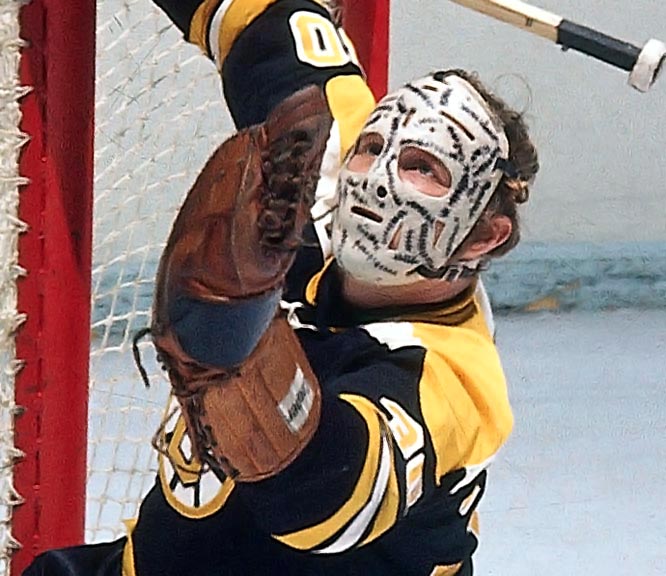
    Gerry Cheevers backstopped some legendary teams in Boston and had the mask to match their toughness. Photo: Denis Brodeur/NHLI via Getty Images
    Gerry Cheevers backstopped some legendary teams in Boston and had the mask to match their toughness. (Photo: Denis Brodeur/NHLI via Getty Images)

    Honorable Mention

    30 Gerry Cheevers/Tim Thomas

    By this point, it’s probably a long shot for the Bruins to retire number 30 out of respect for Gerry Cheevers. He played remarkably well for a dominate Boston team in the 1970s and if it weren’t for the World Hockey Association having diluted the NHL’s talent pool, probably would’ve led the Bruins to some more greatness.

    Likewise, Tim Thomas overcame a lot of doubt to be at the top of the NHL mountain as the Conn Smythe Trophy winner and 2011 Stanley Cup champion. It would certainly be a classy move by the organization, but one that likely will never happen for either (or both) former sensational Boston goaltenders.

    Other Notes

    Personally, I wouldn’t be opposed to setting aside Mark Recchi’s number 28. Not necessarily retiring it, but only using it for special players, which I guess is kind of the reason why nobody has been assigned number 28 on the Bruins since Recchi retired. Same goes with Marc Savard’s number 91.

    It’s a shame that good players don’t always get to have extravagant careers. Players like Savard or Norm Léveillé will always be remembered for how they played on the ice by diehard Boston fans.